―Advancing the communications infrastructure from data centers to homes to support AI applications―
KDDI Corporation
TOKYO, Japan―October 22, 2026―KDDI Corporation today announced a technical partnership with Broadcom Inc. (Headquarters: Palo Alto, California; President and CEO: Hock E. Tan; hereinafter "Broadcom") on network infrastructure technology to advance the social implementation of AI.
Under this partnership, the two companies will collaborate to archive optical-electronic convergence ( Note 1) for inter-GPU networks, aiming to reduce power consumption in AI data centers. Starting today, they will begin a joint verification ("this verification") of Co-Packaged Optics (Note 2) ("CPO") technology. Based on the results of this verification, the companies aim to establish a network architecture that realizes optical-electronic convergence within KDDI's AI data centers.
Furthermore, for in-home broadband services -the final link to our customers- the companies will explore migrating to next-generation FTTH by leveraging Broadcom's expertise in opto-electric conversion technology. By holistically advancing the communication environment from data centers to homes, KDDI aims to create an environment where customers can seamlessly use AI services to generate new AI-powered experiences.
■Background
- With the recent spread of AI, the importance of the communications infrastructure that supports everything from training and inference in AI data centers to AI services used in the home has been increasing. For the further social implementation of AI, it is crucial to have both a high-speed, low-power communication foundation within data centers and a high-bandwidth, low-latency network connecting data centers to homes.
- Broadcom possesses semiconductor and network technologies for AI data centers and communication equipment.
- KDDI possesses technology and expertise cultivated through the construction and operation of communication networks and data centers. In an AI-driven society, KDDI is promoting the realization of its "Digital Belt," which combines assets like data centers and submarine cables with technologies like APN and 6G to build a nationwide low-latency network and AI computing resource infrastructure covering land, sea, and air.
■About this Verification
The two companies will work on reducing the power consumption of networks using CPO technology to achieve optical-electronic convergence for inter-GPU networks in AI data centers.
In this verification, KDDI will build a test environment in its AI data center and introduce a CPO switch equipped with modules of Broadcom's latest generation Ethernet switching chip, "Tomahawk 6" (Note 3), and optical engines "Davisson" (Note 4). In addition to verifying the power reduction benefits of the CPO switch, the companies will evaluate key communication performance -including packet loss, congestion control, and effective throughput- under workloads simulating distributed training and inference.
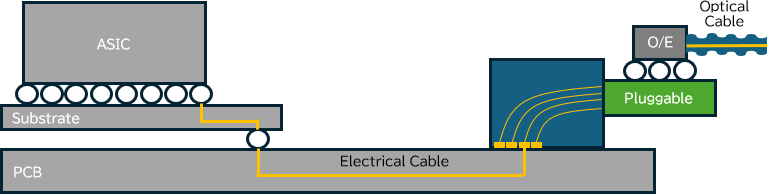
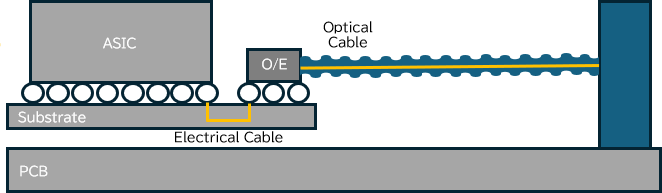
An exhibit related to this partnership and verification will be held at "KDDI SUMMIT 2026," the KDDI Group's largest business event, on October 27th and 28th (Venue: TAKANAWA GATEWAY Convention Center). Free pre-registration is required to attend. For details and registration, please visit the "KDDI SUMMIT 2026" special site (in Japanese only).
- (Note 1)Optical-Electronic Convergence (Optoelectronic Integration): A technology that combines electrical signals used for data processing with optical signals suitable for high-speed, high-capacity data transmission. By shortening the distance electrical signals travel and utilizing optical signals, the power required for communication is reduced.
- (Note 2)Co-Packaged Optics (CPO): A technology for achieving optical-electronic convergence. By placing the optical engine, which converts between electrical and optical signals, in close proximity to the switch chip that processes data, the distance electrical signals travel is shortened, thereby reducing power consumption.
- (Note 3)Tomahawk 6: Broadcom's latest Ethernet switch ASIC, delivering an industry-leading single-chip switching capacity of 102.4 Tbps.
- (Note 4) optical engine: A compact module integrating transmitting and receiving devices with the function of converting electrical signals to optical signals and vice versa.
- *The information contained in the articles is current at the time of publication.
Products, service fees, service content and specifications, contact information, and other details are subject to change without notice.
Downloads