―Japan's first demonstration to capture millimeter-wave signals from outdoor base stations, amplify them, and re-radiate them inside a train―
KDDI Corporation
TOKYO―KDDI Corporation (President, Representative Director and CEO: Hiromichi Matsuda; "KDDI") today announced that it had, in cooperation with East Japan Railway Company (President and Representative Director: Yoichi Kise; "JR East"), successfully demonstrated the expansion of 5G millimeter-wave coverage inside a Yamanote Line train car at JR East's Tokyo General Rolling Stock Center by April 15, 2026 (the "Demonstration"). In this Demonstration, millimeter-wave signals were successfully routed into a stationary train car using a new system where signals from a trackside base station were received by a millimeter-wave glass antenna installed on a train window, then amplified, transmitted, and re-radiated inside the car. This initiative to capture, amplify, and re-radiate 28GHz signals from an outdoor base station into a train car is a first in Japan [ 1].This confirmed that the coverage area capable of achieving 1Gbps improved from 40% to 97% of the entire train car, even within a train car where millimeter-wave signals are typically hard to reach due to the metal structure. KDDI will continue working with JR East to promote the effective use of radio waves, including millimeter-wave bands, improve communication environments along railway lines and in other locations, and advance the digital transformation of railway operations. This Demonstration was conducted in cooperation with AGC Inc. (Representative Director, President and CEO: Yoshinori Hirai; "AGC"), Nihon Dengyo Kosaku Co., Ltd. (President: Tsutomu Taguchi; "DENGYO-KOSAKU"), and Kyocera Corporation (President and Representative Director: Shiro Sakushima; "Kyocera").
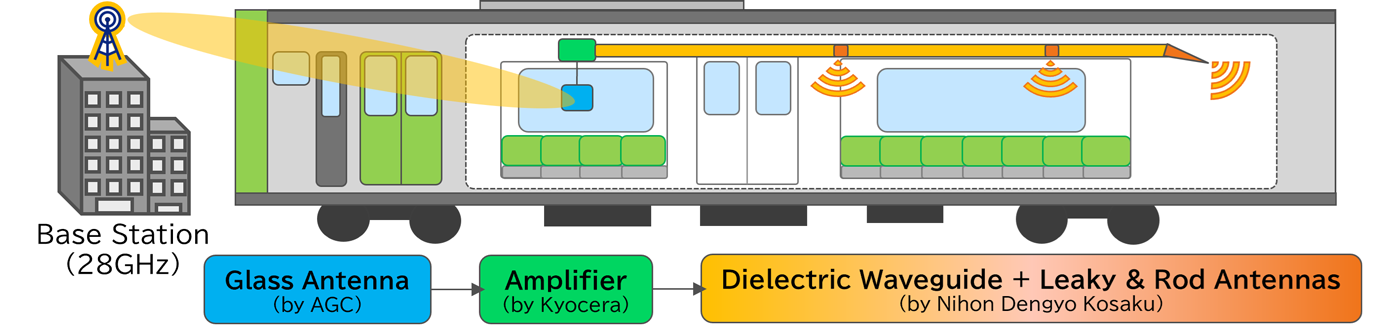
■About the Demonstration
1. Background
While 5G millimeter-wave enables high-speed, high-capacity communication utilizing the wide 28GHz band, its strong signal directivity and susceptibility to obstacles pose challenges for area deployment. To address this, KDDI has been expanding millimeter-wave coverage, mainly in outdoor areas with many obstacles, such as urban areas with many buildings, using wireless repeaters [2] that autonomously form and optimize communication coverage areas. In a joint effort with JR East, following the successful demonstration at Shinjuku Station's platform in April 2025 [3], KDDI expanded millimeter-wave coverage around Takanawa Gateway Station in October 2025 and on the platforms of Tokyo Station's Shinkansen lines in March 2026. Even as millimeter-wave coverage in outdoor and station areas has been expanding, some locations, such as the metallic bodies of train cars which block the signals, are difficult to cover using only existing base stations and repeaters. In this Demonstration, a new system combining multiple technologies was implemented on a Yamanote Line train car to validate its effectiveness in providing millimeter-wave coverage inside train cars, where signals do not easily penetrate.
2. Demonstration Overview
For this Demonstration, a system to re-radiate millimeter-wave signals received from a base station was installed inside a stationary Yamanote Line train car at JR East's Tokyo General Rolling Stock Center. The system involves receiving signals with a glass antenna on the window, amplifying them, transmitting them via a dielectric waveguide, and re-radiating them from desired locations using leaky antennas and a rod antenna. This allows for efficient coverage of necessary areas within the train car.
- (1) Field Testing Location and Period
- Location
- : Yamanote Line train car at JR East's Tokyo General Rolling Stock Center.
- Period (including evaluation)
- : From March 3 to April 15, 2026.
- (2) Evaluation Item
- Communication Area
- : An area where a communication speed of 1Gbps can be achieved.
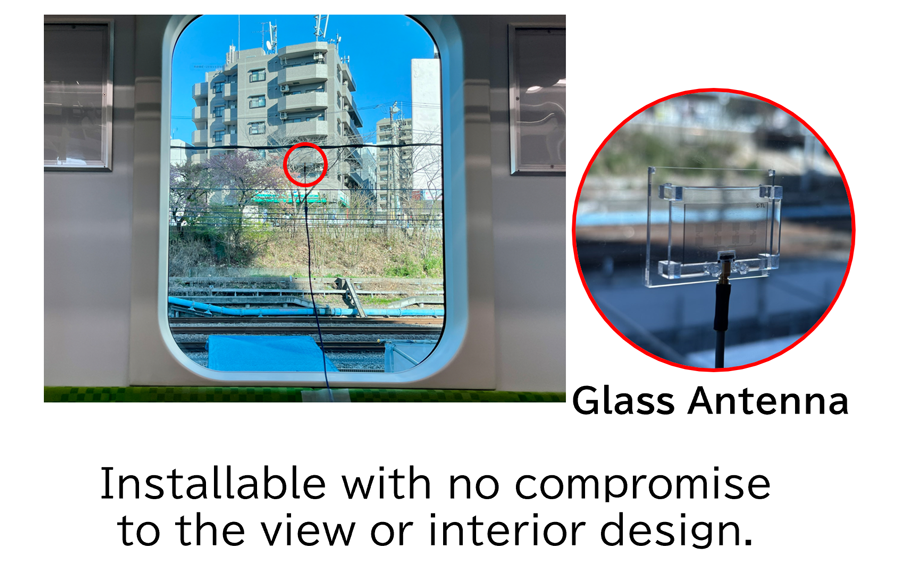
<Glass Antenna Installation> 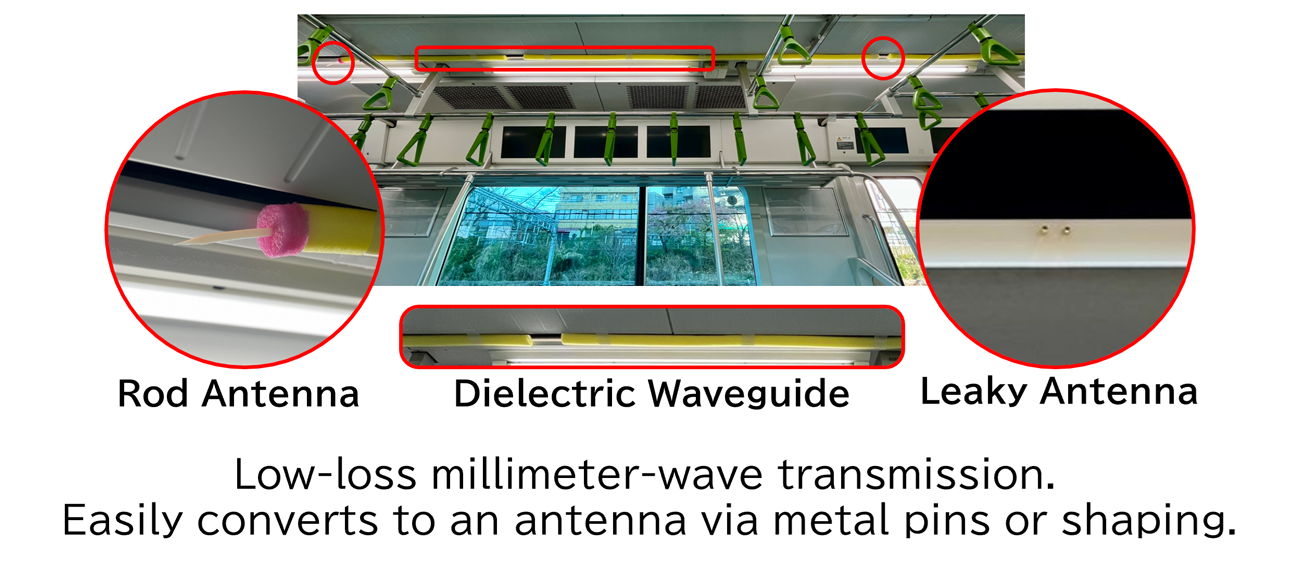
<Dielectric Waveguide, Leaky & Rod Antenna Installation> 【Key Technologies and Features】Glass Antenna A highly transparent antenna that can be retrofitted directly onto indoor-side glass surfaces without compromising the view or interior design. This design minimizes installation constraints, dramatically increases system deployment flexibility, and, by being tailored to the target glass, achieves high-gain millimeter-wave signal transmission and reception. Amplifier A high-gain amplifier for millimeter-wave signals, achieving both low noise and high output. Dielectric Waveguide A transmission line composed of a material with a low dielectric tangent, capable of transmitting millimeter-wave signals with low loss (0.5dB/m). It reduces loss per meter by approximately 83% compared to conventional coaxial cables. Leaky Antenna An antenna installed at any position on the dielectric waveguide. It radiates a portion of the millimeter-wave power from the waveguide, allowing for the efficient delivery of millimeter-wave signals to desired locations. Rod Antenna An antenna formed by shaping the tip of the dielectric waveguide. It efficiently radiates the millimeter-wave power from the waveguide, forming a wide millimeter-wave coverage area.
3. Demonstration Results
The Demonstration confirmed that by re-radiating radio waves from the leaky and rod antennas installed on the train car's ceiling, the impact of shielding was minimized and the communication area within the train car was efficiently expanded. The 1Gbps coverage area improved from 40% to 97% of the entire train car. This demonstrated that the previously discrete coverage areas, caused by signal attenuation from the train car's metal structure, were expanded to cover nearly the entire interior.

4. Roles of Each Company
| KDDI | Overall system design, Demonstration planning, execution, and evaluation |
|---|---|
| JR East | Considering and providing the Demonstration environment |
| AGC | Design and provision of millimeter-wave glass antennas |
| Nihon Dengyo Kosaku | Design and provision of millimeter-wave dielectric waveguides, rod antennas, and leaky antennas |
| Kyocera | Design and provision of high-gain millimeter-wave amplifiers |
5. Future Outlook
Due to their metal structures, train cars are generally considered more challenging for millimeter-wave coverage than typical indoor environments. Leveraging the knowledge gained from this Demonstration, KDDI will work to expand the use of millimeter-wave technology to a wide range of indoor environments, further improving communication quality and customer convenience.
- [1]As of May 20, 2026, according to KDDI research.
- [2]
- [3]
- *The information contained in the articles is current at the time of publication.
Products, service fees, service content and specifications, contact information, and other details are subject to change without notice.
Downloads