―Up to ~50% reduction in network equipment deployment costs, accelerating multi-vendor co-creation through open networking―
KDDI Corporation
TOKYO―KDDI Corporation today announced the launch of commercial deployment of its Cluster-Based Distributed Disaggregated Backbone Router ("DDBR cluster") across major backbone sites [ 1] in Japan, expanding core network capacity to address rapid traffic growth driven by AI and data-intensive applications.
This deployment marks a significant shift toward transforming backbone networks into scalable, open infrastructure designed to meet the demands of AI-driven traffic. KDDI confirmed that this architecture can reduce network equipment deployment costs by approximately 50% [2] compared to conventional chassis-based routers.
The DDBR cluster represents a next-generation, carrier-grade scalable architecture for backbone networks. Unlike traditional chassis routers―where proprietary hardware and software are tightly integrated―the DDBR cluster adopts an open, disaggregated model that separates hardware and software, combined with a distributed cluster design in which multiple devices function as a single logical router.
This architecture enables fine-grained, on-demand capacity expansion aligned with traffic demand, eliminates dependency on proprietary vendor-specific systems, and significantly enhances flexibility in vendor selection and network design. It fundamentally redefines how backbone networks are built and scaled, shifting from monolithic systems to distributed, software-driven infrastructure.
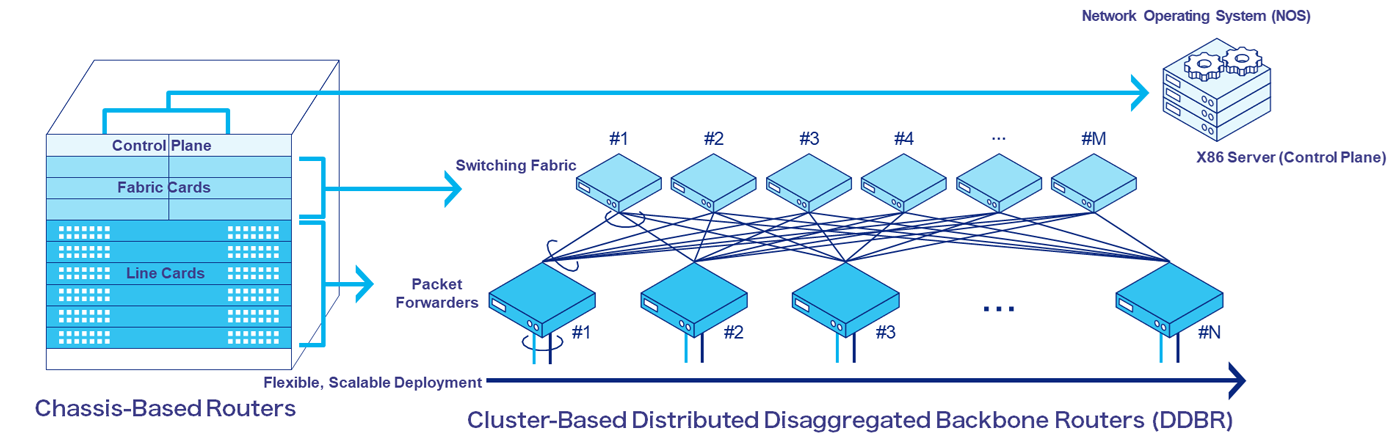
KDDI is one of the leading telecom operators in Japan to execute large-scale commercial deployment of this cluster-based distributed disaggregated backbone router architecture, with the goal of completing nationwide deployment by the end of fiscal year 2027.
Going forward, KDDI will leverage the operational expertise gained through deployment and its proven track record with the DDBR cluster to further accelerate network openness―fostering a multi-vendor ecosystem while strengthening next-generation network infrastructure to support the rapid expansion of AI-driven workloads and data-intensive services across industries.
■Background
Advances in AI technologies, including generative AI, are fundamentally reshaping industries while driving exponential growth in data traffic between data centers and across networks. Traditional chassis-based routers, which tightly integrate proprietary hardware and software, scale capacity in large, fixed increments at the chassis level, making it difficult to efficiently respond to dynamic and rapidly evolving traffic demands.
Against this backdrop, the industry is shifting toward more scalable, flexible architectures and advancing open networking initiatives as a key foundation for next-generation infrastructure.
Since 2020, KDDI has been actively driving the development of open, disaggregated routing technologies through the Telecom Infra Project (TIP) [3]. In June 2023, KDDI completed the commercial deployment of disaggregated routers as internet gateway peering routers [4], marking an early milestone toward more advanced cluster-based architectures. In February 2025, KDDI completed technical validation of the DDBR cluster for commercialization as a backbone core router [5]. In May 2025, KDDI further strengthened its commitment to open networking by entering into a strategic partnership with DriveNets [6].
These efforts position KDDI at the forefront of transforming backbone networks into open, scalable platforms capable of supporting AI-driven traffic growth.
■Deployment Benefits
1. Up to ~50% Cost Reduction with Improved Operational Efficiency
Because the DDBR cluster is based on open architecture principles, KDDI can combine hardware and software without being constrained by a single vendor, enabling more competitive sourcing aligned with performance and operational requirements. This also allows capacity to be scaled incrementally based on demand, avoiding overprovisioning typically required in traditional chassis-based systems.
In this commercial deployment, KDDI uses DriveNets software together with UfiSpace [7] hardware for core routers at major backbone sites, resulting in approximately 50% lower network equipment deployment costs compared with conventional chassis-based routers.
KDDI is also adopting OpenConfig―an industry-standard data model―to enable consistent, vendor-neutral operations across multi-vendor environments. In addition, KDDI has automated key configuration and validation workflows required for DDBR cluster deployment.
As carrier networks become increasingly multi-vendor, vendor-neutral automation is expected to significantly reduce operational complexity, streamline deployment, and lower ongoing operational workloads.
2. Higher End-to-End Network Reliability Through Cluster-Based Resilience
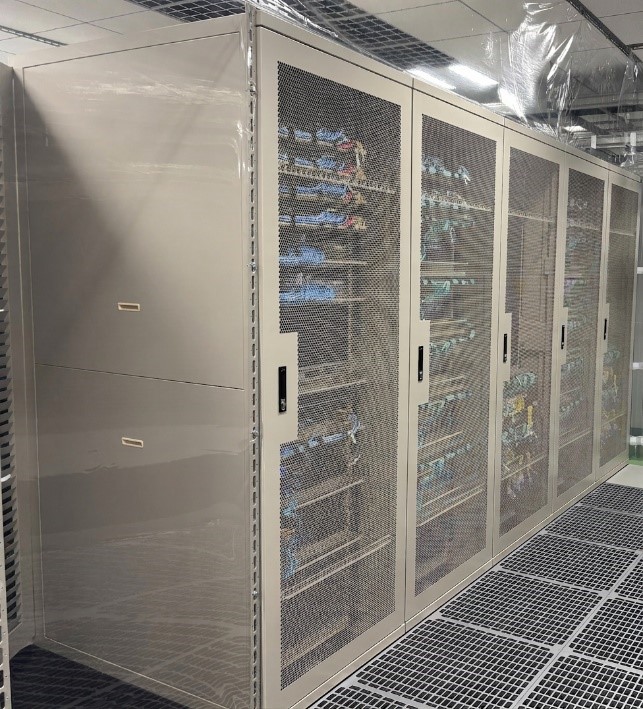
The DDBR cluster scales out by adding devices to increase throughput and system capacity, allowing KDDI to right-size deployments based on traffic demand. In a distributed configuration of multiple smaller routers, processing continues even if part of the system fails.
This built-in redundancy enhances overall network reliability through improved fault isolation and enables more stable, high-quality communications services.
KDDI will continue to promote open networking through its activities in TIP and continue to lead next-generation network infrastructure.
- [1]Backbone network integrates multiple carrier-owned networks, including mobile and fixed-line networks.
- [2]The cost reduction is based on a comparison between the DDBR cluster and a conventional chassis-based router configured to meet equivalent requirements, including software licensing, hardware, and vendor support costs incurred during deployment.
- [3]A non-profit organization established in February 2016 with the goal of reducing the cost of building communication networks through the development of open technologies and accelerating innovation in the telecom sector. Hundreds of companies and organizations around the world participate in the initiative.
- [4]
- [5]
- [6]
- [7]UfiSpace provides end-to-end networking solutions for telecom carriers, cloud service providers, and data centers.
- *The information contained in the articles is current at the time of publication.
Products, service fees, service content and specifications, contact information, and other details are subject to change without notice.
Downloads