―Improving stability of telecommunication quality by 25% and reducing work time for optimization by more than 95%―
KDDI Corporation
KDDI Research, Inc.
Tokyo, February 18, 2026―Aiming to further improve telecommunication quality, KDDI and KDDI Research have introduced a technology in which multiple AIs cooperate [ 1] to autonomously optimize settings of various parameters that influence the operation of a base station (hereinafter referred to as the technology) to base stations in some areas [2] on February 18, 2026.
The technology will be incrementally introduced to base stations across Japan in FY2026 as an effort in the highly autonomous network infrastructure "AI for Network" [3].
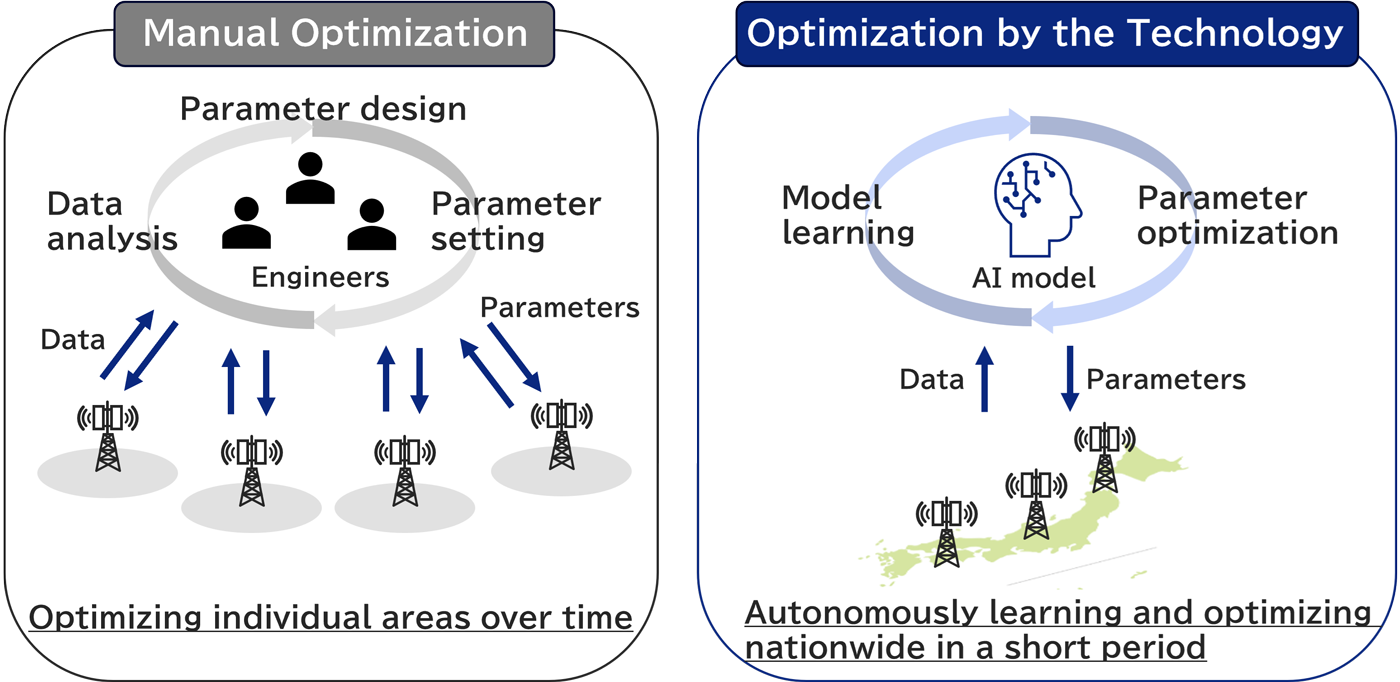
In the areas where the technology has been introduced ahead of other areas, locations where telecommunication tends to slow down due to congestion or other reasons [4] have been improved by 25% compared to before the introduction of the technology. In addition, the technology enables AI to autonomously optimize each base station's various parameter settings that determine the radio emission direction, radio signal strength, user traffic processing method, etc., without manual operation, reducing the work time by more than 95% [5].
KDDI and KDDI Research will continue to further advance the technology to expand it to various use cases related to "AI for Network" such as the automation of operation and design, and provide high-quality telecommunication to more customers.
■Background
- KDDI has focused its efforts on improving telecommunication quality and collected various pieces of data from across Japan. The data enables KDDI to understand the detailed status of telecommunications. On the other hand, to improve the status of telecommunications, it is necessary to derive optimum setting values by analyzing an enormous number of combinations of circumstances surrounding individual base stations and the corresponding parameter settings, which takes a huge amount of time if done manually. Therefore, the automatic optimization of parameter settings utilizing AI is essential.
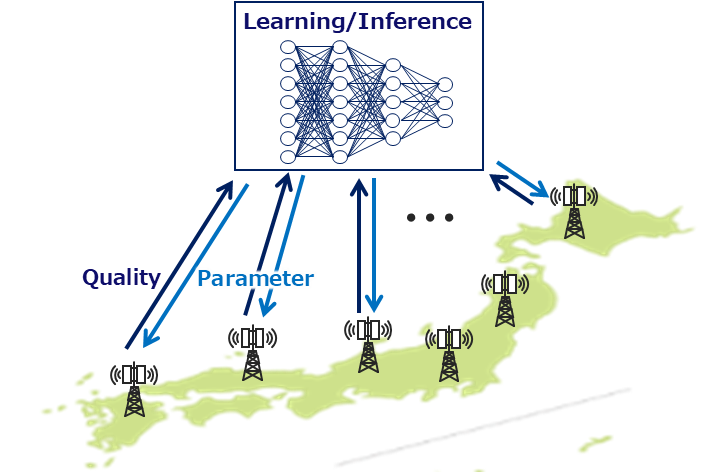
- In the conventional AI utilization (reinforcement learning), "centralized models" which collectively learn and infer multiple base stations are common. However, because a centralized model hugely expands as the number of target base stations increases, it can only be applied to a few dozen stations, and applying it to a large-scale network is difficult.
■Features of the technology
- The technology autonomously searches for and learns parameter setting values and the statuses of telecommunications changed by them to derive the optimum setting values based on distributed reinforcement learning in which multiple AIs cooperate in learning.
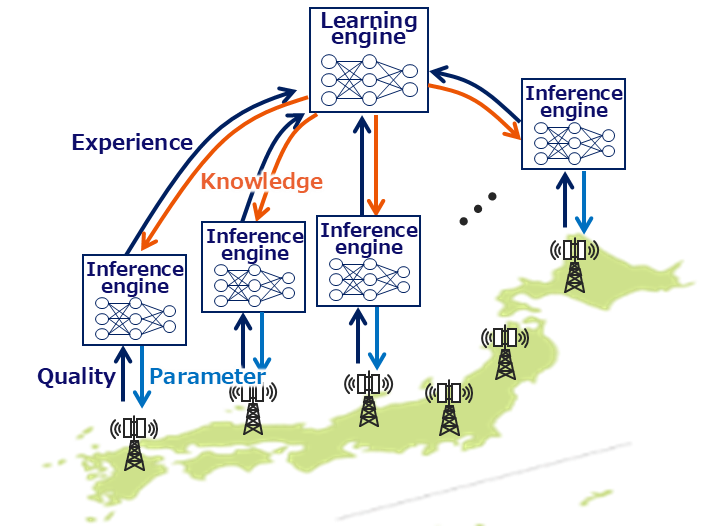
- To efficiently control base stations around Japan, a lot of inference engine that infer and apply the optimum parameter setting values are activated in parallel and assigned to individual base stations. At the same time, a learning engine collects the relations between settings and quality from each inference engine as "experience." By extracting and integrating universal knowledge which is common among base stations and sharing it among all the inference engine, it achieves faster learning and improved accuracy.
- In addition, for collecting data from inference engine, a proprietary technology (patent pending) that selects and transmits only the data that is effective for AI learning has been adopted. It maximizes learning efficiency while reducing traffic. Introducing the technology enables optimization of the parameters of base stations around Japan in real time and with high accuracy.
KDDI and KDDI Research will continue their efforts toward the improvement of telecommunication quality utilizing AI to provide high-quality telecommunications services and improve customer convenience.
■About exhibition at "MWC26 Barcelona"
KDDI will present an exhibition of network operations utilizing AI at the world's largest mobile industry trade show, "MWC26 Barcelona," which will be held in Barcelona, Spain, from March 2 to 5, 2026.
■Related articles
- [1]Refers to a learning engine collects experience from inference engine assigned to individual base stations, extracts and integrates universal knowledge that is common among base stations, and shares it among all the inference engine.
- [2]Areas covered by approximately 12,000 cells throughout Miyagi and Aichi Prefectures.
- [3]An autonomous network infrastructure in which the AI and machine learning technologies are applied to the operation, maintenance, optimization, and security of telecommunications networks.
- [4]Telecommunication areas where the ratio of the telecommunication speed of less than 5 Mbps (KDDI's criterion) is more than 10%.
- [5]It would take about two years and three months for five engineers to optimize 100,000 cells around Japan manually.
The technology enables their optimization in less than a month without additional engineers.
- *The information contained in the articles is current at the time of publication.
Products, service fees, service content and specifications, contact information, and other details are subject to change without notice.
Downloads